
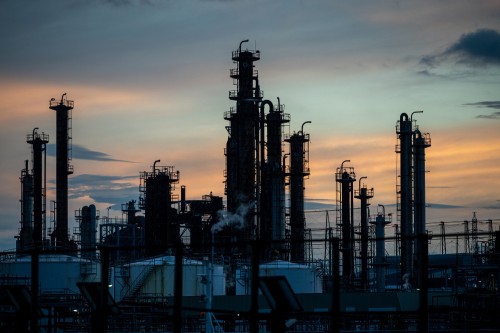
Oil prices surged on Monday amid renewed tensions in the Middle East, heightening inflation concerns and speculation that central banks might raise interest rates. Brent crude, the global oil benchmark, climbed by up to 1.77% to $111.16 per barrel, its highest in nearly two weeks, before settling at $110. This rise followed an attack on a nuclear power plant in the UAE and a social media warning from former U.S. President Donald Trump, who cautioned Iran that “time is of the essence” in stalled peace talks with the U.S. aimed at ending a six-week ceasefire.
Iran’s foreign ministry spokesperson, Esmaeil Baqaei, acknowledged ongoing exchanges through a Pakistani mediator in response to a new U.S. proposal. Meanwhile, global bond markets experienced volatility, with the 10-year U.S. Treasury yield peaking at 4.631% before easing to 4.599%. In the UK, the 10-year gilt yield hit a high of 5.19%, surpassing an 18-year record set last Friday, before settling at 5.15%.
The uncertainty in UK government bonds was exacerbated by political jitters, as traders speculated about a potential leadership challenge to Prime Minister Keir Starmer from Manchester Mayor Andy Burnham. As UK Chancellor Rachel Reeves joined G7 finance ministers in Paris to discuss the Middle Eastern conflict’s economic ramifications, concerns arose over a possible shift to the left in UK politics. Mohit Kumar, Jefferies’ chief economist, noted that such a shift could lead to increased public spending despite the lack of fiscal leeway, with tax hikes potentially proving ineffective.
Kathleen Brooks, research director at XTB, suggested that if the bond market perceives a moderation in Burnham’s spending plans, UK yields might recover. She pointed out that a key test for UK markets would be whether the 10-year yield could dip below 5% and if the 30-year yield would retreat from highs not seen since 1998.
Elsewhere, Japan also saw a rise in bond yields, with the 10-year yield reaching a nearly 30-year high of 2.8% as the government prepared to issue new debt to mitigate the economic impact of the Middle East conflict. In equity markets, Europe’s Stoxx 600 index fell by 0.7%, while the UK’s FTSE 100 remained relatively stable. In Asia, Japan’s Nikkei index dropped by about 1%, Hong Kong’s Hang Seng declined by 1%, Shanghai’s SSE Composite edged down 0.1%, and South Korea’s Kospi closed 0.3% higher.